Tax Flash no. 132
Tax Flash no. 132
I. Key Changes and Updates in Order (OPANAF) 828/2026
1. Mandatory electronic filing and stricter deadlines
II. Impact on Transfer Pricing Documentation and New Details to Be Added
1. Mandatory Excel formats
III. Order 828/2026 Introduces Clarifications and Much Stricter, More Detailed Requirements Regarding How the Comparability Analysis Is to Be Performed
1. Databases used
Order 828/2026 draws a clear distinction regarding the reference point in time for the data, depending on the taxpayer category:
1. Mandatory electronic filing and stricter deadlines
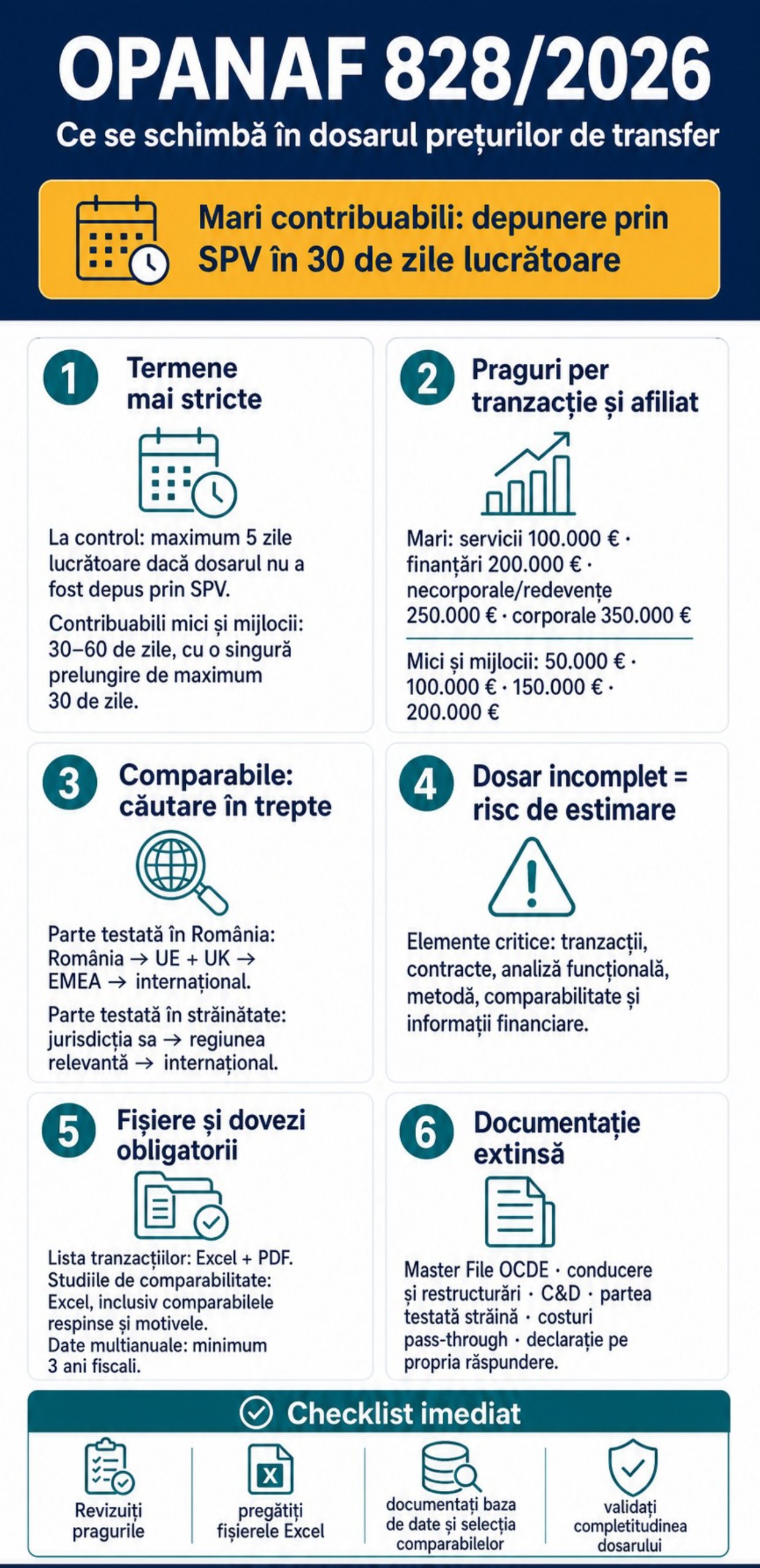
- Filing via the Virtual Private Space (SPV): Large taxpayers meeting the materiality thresholds are now required to file the transfer pricing file electronically, through the Virtual Private Space (SPV), within 30 working days from the legal deadline set for filing the annual corporate income tax return. Under the previous order, the file only had to be prepared by that deadline and made available upon request.
- Reduced time for submission during an audit: Where the file has not been submitted via SPV, the tax authority may request it during an audit, and the deadline for making it available has been reduced from a maximum of 10 calendar days (under the previous order) to a maximum of 5 working days.
- Small and medium-sized taxpayers: For these taxpayers, the deadline for submission upon request by the tax authority during an audit remains 30 to 60 working days, with the possibility of a single extension of no more than 30 working days.
- Calculation method: This is a major change. Under the previous Order 442/2016, the thresholds were calculated by summing the value of transactions with all related parties. Under the new Order 828/2026, the value threshold is determined for each individual transaction with each related party.
- New categories and limits: The new order introduces a specific category for intangible assets and royalties. The new individual thresholds per related party are:
- Large taxpayers: EUR 100,000 for services; EUR 200,000 for financing/interest; EUR 250,000 for intangible assets/royalties; EUR 350,000 for tangible assets.
- Small and medium-sized taxpayers: EUR 50,000 for services; EUR 100,000 for financing/interest; EUR 150,000 for intangible assets/royalties; EUR 200,000 for tangible assets.
- The search strategy for comparables has been refined based on the tax residence of the tested party.
- If the tested party is a Romanian tax resident: The search must be conducted first at the Romanian level, then extended to the European Union level (including the UK), then the EMEA region (Europe, Middle East and Africa), and finally at the international level.
- If the tested party is NOT a Romanian tax resident: The search is conducted in its jurisdiction of tax residence, then extended to the relevant geographic region (EU, EMEA, APAC or Americas), and subsequently to the international level.
- Order 828/2026 explicitly defines what constitutes an incomplete transfer pricing file — a situation that entitles the tax authorities to estimate transfer prices. A file is considered incomplete if it lacks elements such as: the description of the transactions, the contractual documentation, the functional analysis, the justification of the method used, the comparability analysis, or the financial information underlying the calculation.
1. Mandatory Excel formats
- List of transactions (Annex 3): The list of transactions (revenues, expenses, loans, and their respective weightings) must be submitted in mandatory electronic Excel and PDF format.
- Benchmarking studies: These must also be submitted in electronic Excel format. The file must include the search strategy, the selection formulas, the selected comparables (including identifiers and annual financial figures), as well as — critically — the rejected comparables, together with the reasons for rejection.
- The "Group Information" section must now include exactly the information required for the Master File under the OECD Guidelines.
- Management positions: Strategic and/or operational management positions relevant to the transactions analyzed must be disclosed, along with a description of their role at the departmental level.
- Restructurings and R&D: Any local or group-level reorganizations/restructurings must be described in detail, as well as research and development activities or R&D support activities.
- Where the tested party is not the Romanian company (but a foreign affiliate), you are required to submit supporting documentation for the calculation of its profitability indicator. The new order expressly introduces the option to submit a report prepared by an authorized independent auditor certifying the accuracy, amount, and correctness of the calculation of this indicator for the fiscal years documented.
- In light of your earlier questions about recharging costs without a markup, the new Order 828/2026 now requires the explicit disclosure of the amount and nature of costs recharged without adding a profit markup (pass-through costs), both in the introductory section of the file and in the justification of the cost base structure.
- The structure of the transfer pricing file must now include a self-declaration (statement on one's own responsibility) within Section C of the file (Information on the taxpayer/payer and transactions with related parties). Through this declaration, the taxpayer must formally certify the accuracy and correctness of all information included in the transfer pricing file. This additional requirement directly holds the company accountable for the accuracy of the financial data, functional analyses, and benchmarking studies submitted to the central tax authority to substantiate the arm's length value of intra-group transactions.
1. Databases used
- The new order imposes strict transparency requirements regarding the tools used for the comparability analysis. The file must include a presentation of the commercial database used, with the exact name and version indicated. Furthermore, the central tax authority has the explicit right to request additional information to assess the reliability of the extracted data, such as: the geographic coverage of the data, its source, the frequency of database updates, and the criteria by which information is included in that database.
- The order clarifies the period that the studies must cover. Where multi-year data analyses are used, the benchmarking study must cover a period of at least 3 fiscal years. This period generally represents the 3 years preceding the preparation of the file or, where justified (depending on the availability of data in commercial databases), a 3-year period that includes the year in which the file is prepared. To demonstrate the currency of the information, the taxpayer must attach copies of supporting documents showing that the data used was the most recent data available at the time the study was prepared.
Order 828/2026 draws a clear distinction regarding the reference point in time for the data, depending on the taxpayer category:
- Ex-post approach (for large taxpayers): Since these taxpayers are required to prepare the file annually, the benchmarking study is prepared based on data reasonably available at the time the transfer pricing documentation is prepared, for a period as close as possible to the time the transaction took place.
- Ex-ante approach (for small and medium-sized taxpayers): Since these taxpayers only prepare the file upon request, the study is based on data reasonably available at the time the transfer prices were set (i.e., at the time the transactions took place), for a period as close as possible to the transaction.
- To ensure fair treatment, the new order firmly establishes that the identification of comparables, the determination of the comparability range, and the making of adjustments must be carried out based on data and information reasonably available to both the taxpayer and the central tax authority. It is expressly prohibited to use information, data, prices, or profitability indicators that were not available to both parties at the time the transfer prices were documented or set. This rule aligns local legislation with OECD recommendations on avoiding the use of confidential (undisclosed) information to which only the tax authority has access.
- The OECD Guidelines allow two approaches to identifying comparables: the deductive approach (filtering a broad database) and the additive approach (manually selecting specific companies known to be comparable). Order 828/2026 provides that, where the additive method is used, the taxpayer must provide a description of the selection and inclusion process for comparables that allows the process to be verified. This description must demonstrate that the identification of comparables was carried out in a transparent, systematic, and verifiable manner, strictly complying with the comparability principles set out in Chapter III of the OECD Guidelines.